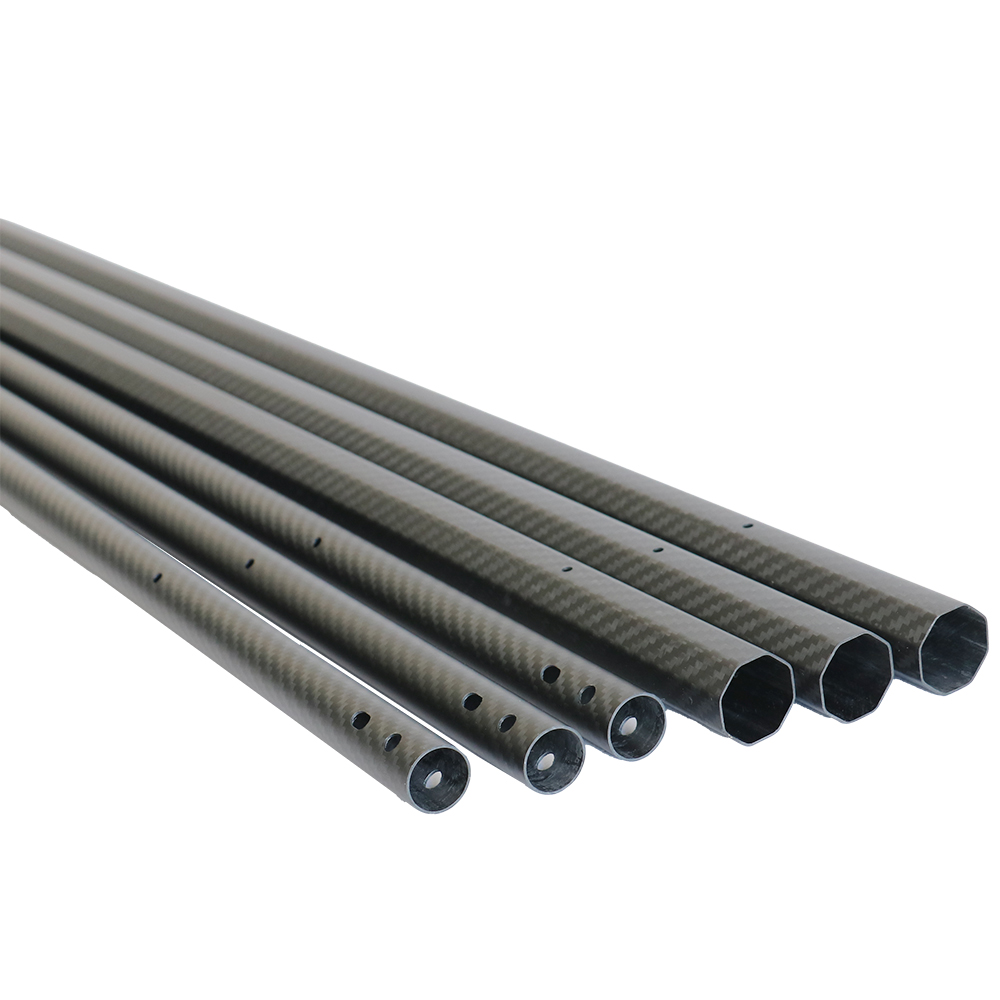
Understanding Carbon Fiber Tube Manufacturing for Industrial Applications
Carbon limit on light structural components Journal of Composite Materials Carbon tubes find increasing application in industrial engineering where lightweight construction, stiffness and precision of dimensions are among the many factors at stake. Unlike conventional metal tubing, which could only be modified in profile or cross section, carbon fiber composites can be tailored to the end-use performance requirements through appropriate materials selection; structural angles of fiber orientations; tube geometry; and manufacturing processes. Knowing about production of these tubes assists engineers to select an appropriate option for the critical applications.
What Are Carbon Fiber Tubes?
Carbon fiber tube manufacturer are composite materials consisting of carbon fibers incorporated within a polymer resin system. The fibers are responsible for nearly all of the tensile strength and stiffness, while the resin binds the reinforcements into a stable composite. They have excellent strength-to-weight characteristics along with resistance to corrosion allow them to be used in industrial, automotive, aerospace, marine, robotics etc.
Important Phases of CF Tube Manufacturing
The choice of manufacturing process depends on the size, production quantity, mechanical properties and application. Some processes include roll-wrapping, filament winding, pultrusion, compression moulding and autoclave processing.
- Material Selection
This begins with choosing the right carbon fiber and resin systems. Based on the applications (stiffness strength weight cost), different grades of modulus can be evaluated The final tube can also be affected by mechanical and environmental impact through the selection of fiber architecture and resin.
- Fiber Orientation and Layup
Composite tube design includes fiber orientation. Depending on the loading conditions, engineers can align fibers accordingly. Longitudinal reinforcement can carry axial loads; additional orientations can provide torsional and circumferential performance.
- Forming the Tube
There are several ways to produce carbon fiber tubing:
- Includes roll-wrapping: good for precision tubes and controlled wall construction.
- Filament Winding: This is important in situations where directional fiber placement and structural reinforcement are essential.
- Pultrusion: It is suitable for the mass production of long straight profiles.
- Compression Molding and Autoclave Processing: If the composite application is more specific.
TipTop Composites lists capability in each of these composite tube and component manufacturing processes.
- Curing and Consolidation
The composite can then be cured to allow the resin matrix to form a strong enough structure. Curing is an important process control for maintaining quality and reducing defects during manufacturing.
- Machining and Finishing
After the tube is manufactured possibly further operations will be needed. Things like CNC cutting, drilling, sanding and finishing to tapering can all be used in preparing components for assembly. TipTop Composites also offers precision machining and assembly of composite products.
Factors To Look Into When Choosing Industrial Carbon Fiber Tubes
When it comes to industrial applications, the manufacturers need to keep the following points in mind:
- Necessary width, height, and thickness of any Container
- Loading direction and anticipated working situations
- Ultimate strength and modulus of carbon fibre
- Required cross-sectional shape
- Surface finish and dimensional tolerances
- Production quantity and tooling requirements
- Machining, bonding, or assembly requirements
Carbon fibre tubes can be manufactured in round, square, rectangular, hexagonal, octagonal, curved and other custom formed profiles to suit the design of each application for specific engineering needs.
Industrial Applications of Carbon Fiber Tubes
The high strength to weight ratio, along with a combination of stiffness and corrosion resistance, makes carbon fiber tubing ideal for numerous applications. They comprise of industrial machinery, robotic parts, automation systems, UAV frames, automotive products, marine plants/equipment and special sporting crates.
These considerations can help confirm dimensions, materials, manufacturing methods and performance requirements before any production for custom projects as well; Engineering support and prototyping also are helpful. Intro TipTop Composites specializes in design, engineering, prototyping, tooling, manufacturing and machining and assembly of composite goods.
Conclusion
The science behind the manufacturing of carbon fiber tubes, with its application in industrial products, provide engineers and product developers with insights that will benefit their material/design decisions. Every step of the process from fiber orientation forming method to curing, machining and quality control can affect the final component. TipTop Composites offer carbon fibre tube solutions tailored around different industrial requirements, with custom engineering and multiple manufacturing capabilities.